The Invisible Highways of the Digital Age
If someone told you that most of the world’s information travels through thin strands of glass no thicker than a human hair, you might assume they were exaggerating. But that astonishing idea is the foundation of modern communication. From video streaming to cloud computing to international banking and global commerce, the systems that run our lives depend on fiber optics—networks that move unimaginable volumes of data using pulses of light. Fiber optics is not just another networking technology; it is the backbone of the modern world. It links continents, powers national infrastructure, connects billions of devices, and enables businesses and individuals to communicate at nearly the speed of light. Yet for all its importance, fiber optics remains mysterious to many. How does light travel inside a glass strand without escaping? What makes fiber so much faster than traditional copper wiring? And how does this invisible technology manage to transport billions of messages, videos, and signals every second? This beginner’s guide breaks down the fascinating science behind fiber optics in a clear, engaging, and accessible way. Whether you are a student, a tech enthusiast, or simply someone who wants to understand the systems powering the digital world, this exploration will leave you with a deeper appreciation for one of humanity’s most extraordinary engineering achievements.
A: Often, especially for upload, but local plan tiers and equipment still matter.
A: No. Fiber brings service to the home; Wi-Fi distributes it indoors.
A: Construction cost, permits, pole access, and local demand shape deployment.
A: Only if your devices, router, and workload can use that speed.
A: Yes. Power failures, equipment faults, and cable cuts can still interrupt service.
A: Yes, when routing and home networking are also strong.
A: Upload affects calls, backups, creators, cameras, and remote work.
A: Run wired and wireless tests in the rooms where service matters.
A: Yes. Local and municipal providers can be excellent where available.
A: The plan with enough speed, fair pricing, low latency, and dependable support at your address.
The Basics: What Exactly Is Fiber Optics?
Fiber optics refers to the technology of transmitting data using beams of light through flexible, transparent fibers usually made of glass or plastic. Each fiber is incredibly thin—around the width of a hair—but capable of carrying vast amounts of information. These fibers are bundled together into cables that run beneath streets, under the ocean, across mountains, and through the walls of your home or office.
Unlike copper wires, which transmit electrical signals, fiber optics uses light. And because light moves faster and experiences far less interference, fiber offers speed, stability, and bandwidth that copper cannot match.
At its core, fiber-optic communication relies on three essential elements: a light source that generates signals, a transparent fiber that guides the light, and receivers that decode the signals back into usable information. Through this elegant structure, fiber carries everything from emails and phone calls to entire cloud storage systems, financial trades, and high-resolution video streams.
Light as Information: How Data Becomes Beams
To understand fiber optics, it helps to look at how information is transformed into light. Every message you send—whether a video call, a web search, or a file upload—becomes a digital stream of ones and zeros. These binary numbers are converted into rapid pulses of light emitted by a tiny laser or LED inside a transmitter. When the light turns on, it represents a 1. When it turns off, it represents a 0.
These pulses occur at extraordinary speeds. Modern fiber systems can flash billions of times per second, transmitting data at rates that make human time perception seem slow in comparison. Once the light enters the fiber, the magic begins.
Total Internal Reflection: The Secret Behind Fiber’s Power
The most pivotal concept in fiber optics is total internal reflection, a principle of physics that allows light to bounce repeatedly within a glass strand without leaking out. Think of it like sending a beam through a perfectly mirrored tunnel. As the light travels down the fiber, it hits the boundary between the inner core and the outer cladding at such an angle that it reflects inward rather than escaping.
This continuous reflection keeps the light trapped inside, guiding it over vast distances—even hundreds of miles—without significant loss. And because glass has extremely low attenuation (signal weakening), light can travel far more efficiently than electrical signals through copper.
A single fiber can carry multiple wavelengths of light simultaneously, each carrying its own data stream—a technique known as wavelength-division multiplexing (WDM). This dramatically increases the amount of information that a single fiber can transmit. In practical terms, one fiber can carry tens of thousands of HD videos simultaneously without interruption.
Inside a Fiber-Optic Cable: Layers of Engineering Mastery
Although each fiber is incredibly thin, a fiber-optic cable is built like a piece of advanced armor. It needs protection from moisture, bending, rodents, pressure, temperature changes, and physical forces. Most cables include several key layers:
The core: the central glass strand where light travels.
The cladding: a reflective layer surrounding the core that keeps the light trapped.
The coating: a protective buffer that adds flexibility and shock absorption.
Strength members, often fiberglass or steel, provide structural durability, especially in submarine cables.
An outer jacket defends the cable from environmental hazards such as water, chemicals, or physical impact.
Submarine cables—the giants that cross oceans—add protective steel wiring, copper power lines, and waterproof barriers. These cables are feats of engineering, built to survive decades on the ocean floor despite storms, currents, and pressure.
Single-Mode vs. Multimode Fiber: Why Two Types Exist
Fiber optics comes in two main varieties: single-mode and multimode. They serve different purposes and excel in different environments.
Single-mode fiber has an especially small core, allowing light to travel in a single, straight path. This reduces distortion and enables longer distances—tens or even hundreds of miles. Single-mode fiber is used in long-haul networks, metro systems, and high-capacity backbones.
Multimode fiber has a larger core that allows multiple light paths. It is ideal for shorter distances, such as inside buildings, data centers, and campuses. Multimode fiber is easier to work with and supports high speeds over moderate distances. Both play crucial roles in the global fiber ecosystem, ensuring that every environment—from skyscrapers to undersea routes—has the right performance and cost balance.
How Fiber Networks Are Built: From Local Streets to Global Oceans
A fiber network is more than just cables. It is a carefully engineered system of infrastructure that includes:
transmitters that encode data into light
optical line terminals that manage signals
amplifiers that boost light over long distances
splitters that distribute signals to neighborhoods
receivers that convert light back into usable information
These elements create a seamless path from your device to the wider world.
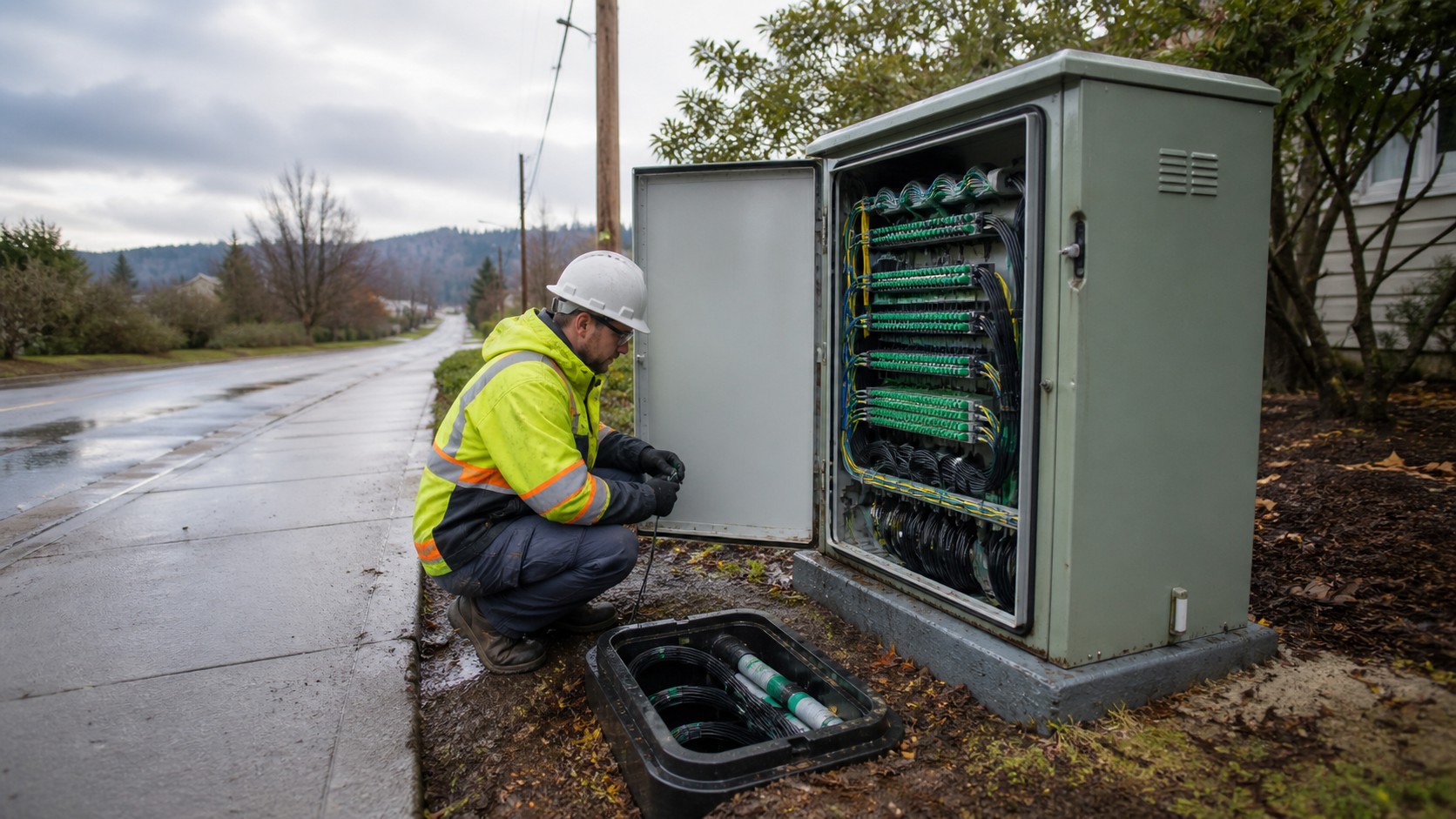
Within cities, fiber is installed under streets, through conduits, or across utility poles. In rural areas, it may be buried or laid alongside existing infrastructure. For international communication, submarine cables are deployed by massive cable-laying ships that carefully position fiber along the ocean floor—sometimes thousands of miles long. The result is a global web of light, with signals traveling across continents and oceans in the blink of an eye.
Why Fiber Is So Fast: The Physics Advantage
Fiber’s incredible speed comes from several factors:
Light travels faster in glass than electricity does in copper.
Fiber experiences far less interference from outside sources.
It carries multiple wavelengths of light, multiplying capacity.
It supports extremely high frequencies and bandwidths.
Compared to copper cables, fiber reduces signal loss, avoids electromagnetic interference, and offers future-proof speeds capable of supporting decades of technological advances. As demands for 4K video, VR, cloud services, and AI increase, fiber remains the only infrastructure that easily keeps pace.
Fiber Optics in Everyday Life: You Use It Constantly
Even if your home is not yet connected by fiber, the services you use nearly always are. Every major streaming service, online retailer, social media platform, and cloud provider depends on fiber backbones. When you send a message or upload a file, your data travels primarily through fiber until it reaches the destination server. Hospitals, research labs, airports, energy grids, universities, and stock exchanges all rely on fiber networks. Autonomous vehicles communicate through fiber backhaul. Smart city systems run on fiber. Even the wireless networks we use daily depend on fiber cables feeding cell towers. If the world is a body, then fiber optics is the nervous system connecting every part.
Fiber’s Role in Data Centers and the Cloud
Data centers—the physical homes of the cloud—are filled with fiber connections linking servers, switches, and storage systems. Fiber ensures low latency, massive throughput, and stable long-distance communication inside these digital hubs.
Cloud computing giants like Amazon, Google, and Microsoft operate enormous fiber networks worldwide, transporting data from regional data centers to local nodes and end users. Fiber is the silent engine powering everything from video calls to AI processing to online gaming. Without fiber optics, the global cloud would collapse under its own demand.
The Future of Fiber: Faster, Smarter, and More Powerful
The evolution of fiber optics is far from over. Engineers are developing new innovations such as:
hollow-core fiber that lets light travel even faster
coherent optical transmission pushing speeds beyond 1 Tbps
space-division multiplexing using multiple cores in one fiber
AI-driven fiber monitoring systems
quantum-secure optical communication
Fiber is future-proof because its limits are dictated by physics, not by materials. Unlike copper, which reached its ceiling decades ago, fiber can continue evolving with new modulation formats, wavelengths, and capacities. As global traffic skyrockets with AI workloads, streaming, automation, and digital infrastructure expansion, fiber will remain indispensable.
Why Fiber Matters: More Than Speed
Fiber optics is not just about speed. It represents reliability, scalability, security, and resilience. It powers entire economies, connects billions of people, and supports systems that can’t afford failure.
From national defense to smart homes, from education to entertainment, fiber forms the invisible foundation of the digital era. Understanding how it works gives us a deeper appreciation of how modern life is stitched together by beams of light traveling through strands of engineered glass.
Light at the Heart of the Connected World
The story of fiber optics is the story of progress—scientific, technological, and societal. What began as an experiment in guiding light has grown into the backbone of global communication. Today, fiber optics moves the world’s data with precision, elegance, and astonishing speed. And as the need for hyper-fast connectivity expands, fiber will continue to illuminate the path forward. Whether you’re browsing at home, building a business, studying engineering, or exploring the systems behind modern communication, understanding fiber optics opens a window into the remarkable technology shaping our future.