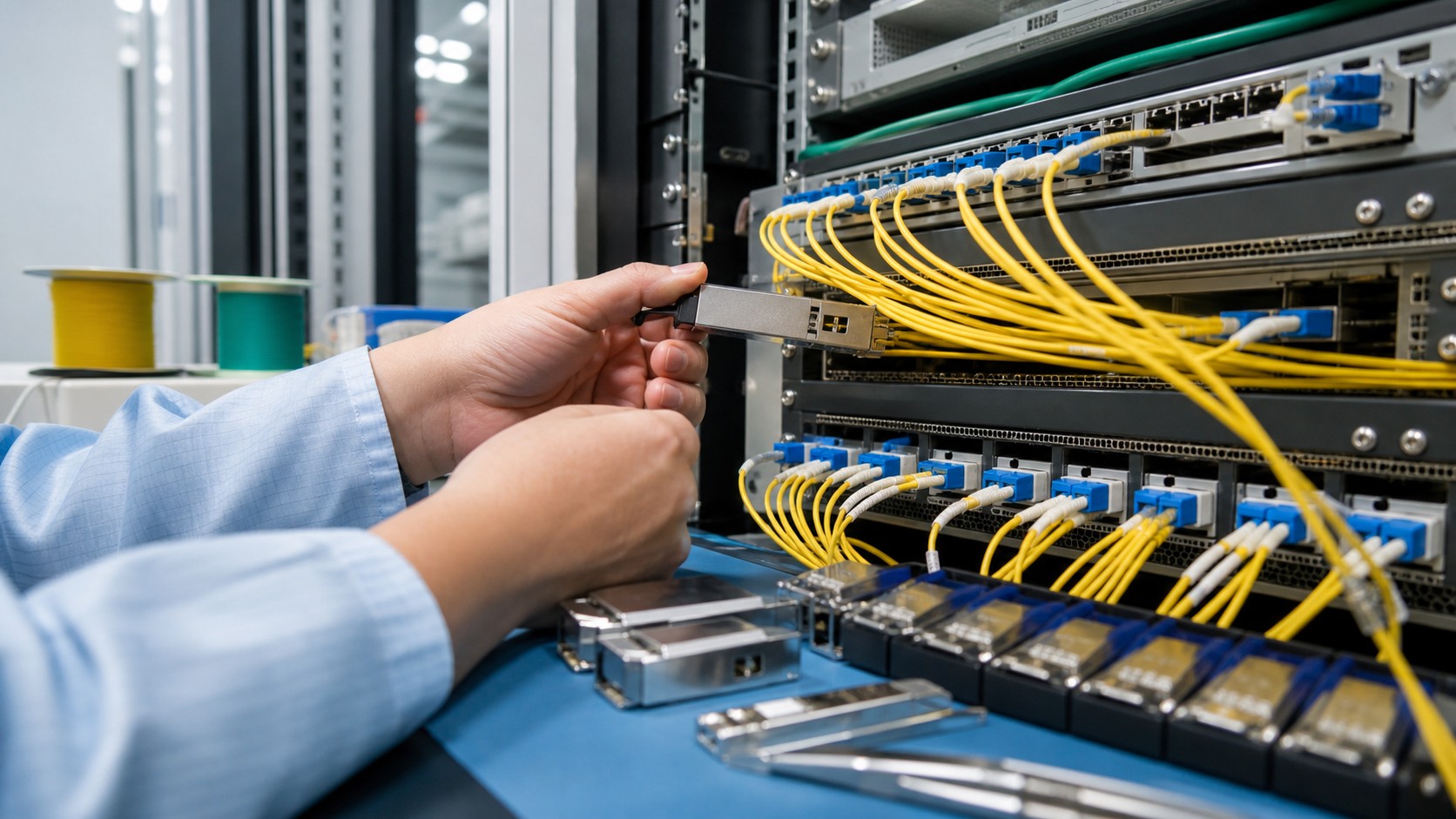
The Global Highway Made of Light
Every message you send, every video you stream, every map you load, and every cloud service you rely on travels through a hidden world beneath streets, oceans, and city skylines. This world is not powered by metal cables carrying electricity or by radio towers broadcasting over the air. Instead, it is powered by something far more elegant and astonishing: light. Inside the glass threads of the fiber-optic network—the backbone of global communication—light carries the world’s data with speed, precision, and breathtaking efficiency. Nearly everything that moves across the modern internet relies on this invisible web. From emojis to enterprise cloud systems to real-time financial transactions, fiber optics transports information in pulses of light traveling through strands thinner than human hair. Understanding fiber optics is not simply learning how internet cables work. It is uncovering one of the most transformative engineering breakthroughs in human history. This technology has reshaped economies, collapsed distances, connected cultures, and fueled entire industries. It powers everything from telemedicine and video conferencing to artificial intelligence and space exploration. In this deep-dive guide, you’ll step inside a fiber-optic network to discover how it’s built, how it transmits data, how signals maintain clarity across continents, and how light itself carries the digital heartbeat of the modern age.
A: Often, especially for upload, but local plan tiers and equipment still matter.
A: No. Fiber brings service to the home; Wi-Fi distributes it indoors.
A: Construction cost, permits, pole access, and local demand shape deployment.
A: Only if your devices, router, and workload can use that speed.
A: Yes. Power failures, equipment faults, and cable cuts can still interrupt service.
A: Yes, when routing and home networking are also strong.
A: Upload affects calls, backups, creators, cameras, and remote work.
A: Run wired and wireless tests in the rooms where service matters.
A: Yes. Local and municipal providers can be excellent where available.
A: The plan with enough speed, fair pricing, low latency, and dependable support at your address.
The Foundation of Fiber Optics: Light as Information
To grasp how fiber-optic networks work, start with the remarkable idea that information can be encoded into light. Instead of electrons traveling through copper wire, fiber-optic systems use tiny bursts—pulses—of light to represent binary data. When the light turns on, it represents a digital “1.” When it turns off, it represents a “0.”
These light pulses are generated by lasers or LEDs inside an optical transmitter. They flicker billions of times per second—far faster than anything electrical systems can achieve. The speed alone is impressive, but the real miracle is how far these signals can travel without degrading.
Inside a fiber-optic cable, light travels down a tiny central glass core. Despite its size, this core is engineered with extraordinary purity so that photons—the particles of light—can travel smoothly, hitting almost no imperfections. Fiber makes it possible for light to traverse dozens, even hundreds, of miles before needing a boost from an amplifier. While electricity is powerful, light is infinitely cleaner, faster, and more cooperative for long-distance communication. It is the ultimate messenger in a world that depends on instant information.
The Architecture of a Fiber-Optic Cable
A fiber-optic cable may look unassuming from the outside, but inside it is a marvel of layered precision. Each cable contains multiple fibers, and each fiber consists of three essential layers that work together to guide the light.
At the center is the core, made of ultra-pure glass. This is where the light travels. Surrounding the core is the cladding, a layer of glass with a different refractive index that reflects light inward. It forms a mirrored boundary that keeps light contained. Finally, the coating protects the delicate glass from physical damage and environmental stress.
These fibers are bundled into cables fortified with strength members, waterproof barriers, gel buffers, Kevlar wraps, and protective outer jackets. Some cables—especially submarine cables—contain steel armor, copper power conductors, and layers designed to withstand decades of pressure, currents, and shifting seafloor terrain. A single fiber might seem fragile, but when properly constructed and protected, fiber-optic cables are among the most resilient components of modern infrastructure.
Total Internal Reflection: The Secret of Light’s Journey
The journey of light through a fiber is made possible by a phenomenon called total internal reflection. This optical principle ensures that when light enters the glass core at a precise angle, it bounces repeatedly off the boundary between the core and the cladding—without escaping.
Imagine a corridor of perfect mirrors. Light enters at one end and reflects endlessly, staying trapped as it moves forward. This is exactly what happens inside fiber optics. The cladding’s refractive index is slightly lower than the core’s, creating a reflective surface that guides each photon in a zigzag path over long distances.
This controlled reflection allows fiber signals to travel incredible lengths while preserving clarity. Even across continents, signals remain clean enough to be amplified and regenerated with minimal distortion. This is a key reason fiber has revolutionized global connectivity: it allows tiny amounts of light to cross vast distances with remarkable fidelity.
Encoding Data Into Light: Lasers, LEDs, and Modulation
Light alone doesn’t transmit information—it must be structured and shaped to carry meaning. This is where modulation comes into play.
Inside an optical transmitter, lasers or LEDs generate light at specific wavelengths. These light waves are rapidly turned on and off, adjusted in amplitude, phase, or frequency, and encoded with digital information. Modern fiber systems use advanced modulation formats that pack enormous amounts of data into each pulse.
The transmitter converts electrical signals from computers, servers, or routers into optical form. Once converted, the photons carry billions of bits of information per second through the fiber. At the receiving end, a photodiode or similar detector transforms the light back into electrical signals that devices can interpret. The entire process happens so quickly and so precisely that online interactions feel instantaneous.
Wavelength Division Multiplexing: Many Colors, One Fiber
One of the most extraordinary capabilities of fiber-optic networks is wavelength-division multiplexing (WDM). Instead of sending just one stream of light, engineers discovered how to send multiple wavelengths—different colors—through the same fiber simultaneously. Each wavelength acts like its own invisible lane traveling down the same optical highway. One fiber strand can carry dozens or even hundreds of wavelengths, each transmitting data independently.
This technique multiplies capacity without adding more cables. It is the reason a single fiber can carry terabits of data per second—enough to support entire cities or national backbones. Imagine if a single road could hold hundreds of parallel lanes without expanding in physical size. WDM is that road for the digital world.
Inside Fiber Networks: Local Access, Backbones, and Global Routes
A fiber-optic network is not one cable but a vast, interconnected system. It begins at the local level, extends to regional infrastructure, and ultimately spans the planet.
At the local access layer—also known as the “last mile”—fiber connects homes and businesses to nearby distribution hubs. For many users, this is the fiber-to-the-home line that powers their modem or optical network terminal.
Beyond local access lies the metro network, which links neighborhoods, business districts, and data centers across a city or region. These networks handle large volumes of traffic and maintain high reliability.
Above them is the long-haul network, or backbone. These fiber routes stretch across states, countries, and continents. They are buried underground, strung across utility poles, or suspended under bridges. The most impressive are submarine cables—thousands of miles long—laid across ocean floors to connect continents.
Nearly every international transaction, email, or streaming connection crosses these undersea networks. Satellites, despite their size and appeal, carry only a tiny fraction of global internet traffic. Fiber optics does the heavy lifting, carrying roughly 99% of the world’s data.
Optical Amplifiers: Boosting Light Across Continents
Light weakens as it travels, even in the purest glass. To maintain signal strength, fiber networks use optical amplifiers—devices that boost light without converting it back to electricity.
Amplifiers like erbium-doped fiber amplifiers (EDFAs) use rare-earth elements to strengthen light across multiple wavelengths simultaneously. They’re often placed every few dozen miles along long-haul routes.
For submarine cables, amplifiers sit inside pressure-resistant housings along the ocean floor. They operate for decades without maintenance—a testament to engineering mastery.
These amplifiers allow uninterrupted data flow between continents, ensuring that light carries your information across oceans as effortlessly as it crosses your street.
Data Centers: The Command Centers of Fiber Networks
No fiber-optic network exists in isolation. Fiber is the circulatory system, but data centers are the heart. These massive facilities house servers, storage clusters, switches, and routers that store, process, and forward data.
Every cloud service—from social media to online banking—relies on fiber links connecting data centers worldwide. When someone streams a movie, the request travels through local and global fiber routes to the nearest data center, retrieves the file, and streams it back through the same optical pathways. Fiber makes this instantaneous. Without it, modern digital life would collapse under the weight of global demand.
Latency and Speed: Why Fiber Is the Gold Standard
Fiber’s performance advantage extends beyond raw speed. It also offers lower latency—the time it takes for data to travel from point A to point B. Because light experiences minimal resistance and interference, fiber can deliver near-instant responses.
For real-time applications such as gaming, telemedicine, financial trading, autonomous vehicles, and live communication, low latency is essential. Fiber delivers consistently low latency even under heavy load.
Cable networks and wireless systems struggle with congestion, electrical noise, and bandwidth sharing. Fiber remains steady, reliable, and incredibly fast in comparison.
Why Fiber Is the Future of Global Communication
The digital world increasingly depends on cloud computing, remote work, AI, VR, autonomous systems, and real-time analytics. All of these require vast bandwidth, instant responsiveness, and networks capable of scaling indefinitely.
Fiber is uniquely positioned to meet these demands.
Its capacity is not limited by the glass itself—only by the electronics on each end. Upgrades often involve swapping devices rather than replacing buried cables. This makes fiber one of the most future-proof technologies humanity has ever created.
As infrastructure expands, more communities will gain access to full fiber networks, closing the digital divide and enabling new possibilities in communication, medicine, education, and industry.
A World Moved by Light
Fiber-optic networks are more than just cables and electronics—they are the invisible architecture of modern civilization. They connect continents, empower economies, and enable instantaneous communication across the globe.
Inside each fiber, pulses of light race through glass tunnels to carry the dreams, ideas, and conversations of billions. They move with astonishing precision, transmitting the world’s data through a system so advanced it borders on magical.
Understanding how fiber-optic networks work offers a glimpse into the elegant fusion of physics and engineering that forms the digital world’s foundation. And as our global appetite for data continues to grow, fiber-optic networks will illuminate the path forward—one beam of light at a time.