
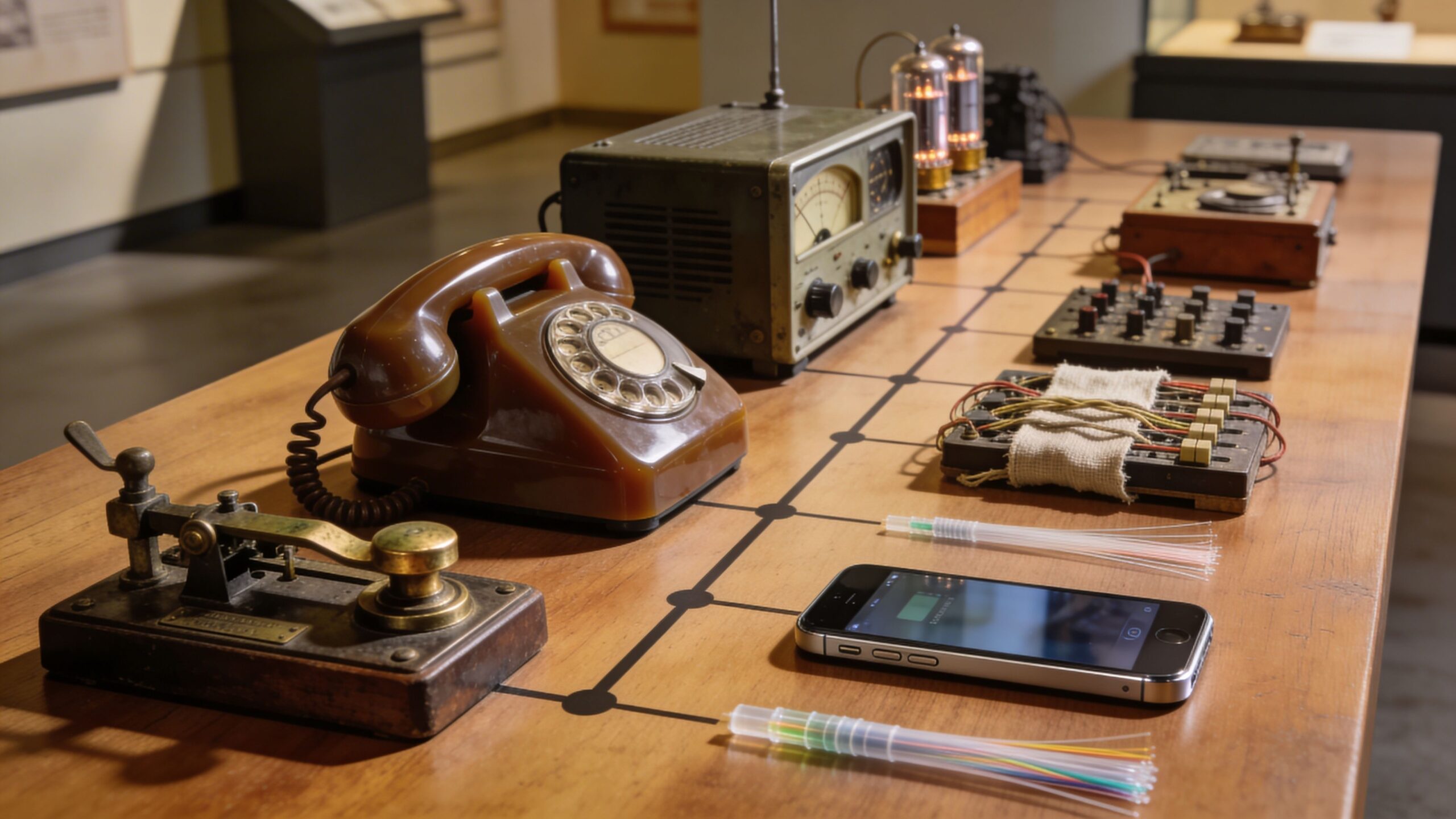
Step into the Telecom History Timeline, where the story of global communication unfolds across decades of innovation, invention, and technological breakthroughs. Long before smartphones and high-speed internet connected billions of people, early pioneers were experimenting with telegraph wires, radio signals, and the first telephone networks. Each breakthrough pushed communication farther, faster, and across greater distances. This section of Telecommunication Streets explores the milestones that transformed simple signals into the vast global networks we rely on today. From the earliest telegraph messages traveling across copper wires to the rise of satellite communications, fiber-optic cables, mobile networks, and the internet, the telecom timeline reveals how each advancement built upon the last. Here you’ll discover the turning points that shaped modern connectivity: the invention of the telephone, the expansion of global radio broadcasting, the birth of digital switching, and the evolution of wireless networks from early cellular systems to today’s high-speed technologies. The Telecom History Timeline helps bring these moments together into a clear, fascinating journey through the past, showing how communication technology evolved to connect the modern world.
A: It traces the major inventions and milestones that shaped modern communication systems.
A: The telegraph was one of the earliest long-distance communication systems.
A: Telephone networks expanded rapidly during the early 1900s.
A: It enabled wireless broadcasting across large regions.
A: They enabled global communication and broadcasting.
A: Fiber optic cables now carry massive digital data using light.
A: They allowed mobile voice and data communication anywhere within coverage.
A: It integrated voice, data, video, and messaging into global networks.
A: Yes, new technologies continue to expand speed and connectivity.
A: It helps explain how today’s global communication systems developed.