Wireless internet has become one of the most essential technologies in modern life. Whether you’re streaming movies in 4K, competing in online gaming tournaments, attending video conferences, managing a smart home, or simply browsing the web, your Wi-Fi network plays a critical role in your daily experience. Yet many consumers encounter technical terms like Wi-Fi 5 and Wi-Fi 6 without fully understanding what they mean or whether upgrading is worthwhile. At first glance, the transition from Wi-Fi 5 to Wi-Fi 6 may seem like another routine technology refresh. Marketing materials often focus on bigger speed numbers and newer hardware, but the reality is much more interesting. Wi-Fi 6 isn’t simply about achieving faster downloads—it represents a fundamental shift in how wireless networks manage multiple devices, reduce congestion, improve efficiency, and deliver a more reliable experience in increasingly connected environments. To understand whether Wi-Fi 6 is worth the investment, it helps to examine what each standard offers, how they differ, and how those differences affect real-world performance.
A: Distance, walls, interference, and mesh backhaul are common causes.
A: Test with Ethernet first so you know whether the provider or Wi-Fi is the bottleneck.
A: No. It can be faster nearby, but it has shorter range through walls.
A: No. They help coverage only when nodes are placed where they can still hear each other well.
A: Yes. It is still the steadier choice for gaming, workstations, and backhaul.
A: Yes. Older clients can limit their own speed and sometimes use airtime inefficiently.
A: Usually one name is fine, but separate names can help troubleshoot stubborn devices.
A: Open, central, elevated, and away from metal or dense obstructions.
A: More household and neighborhood traffic can expose capacity limits.
A: Restart once, update firmware, then test near the router and in the slow room.
Understanding Wi-Fi Generations
Before diving into technical comparisons, it’s important to understand the naming convention. For years, wireless standards carried technical labels such as 802.11ac and 802.11ax. While accurate, these names often confused everyday consumers.
To simplify things, the Wi-Fi Alliance introduced a more user-friendly naming system. Under this system, 802.11ac became Wi-Fi 5, while 802.11ax became Wi-Fi 6.
Wi-Fi 5 arrived in 2014 and quickly became the dominant wireless standard for homes and businesses. It provided substantial improvements over earlier generations and enabled the growth of streaming services, cloud applications, and high-speed broadband connections.
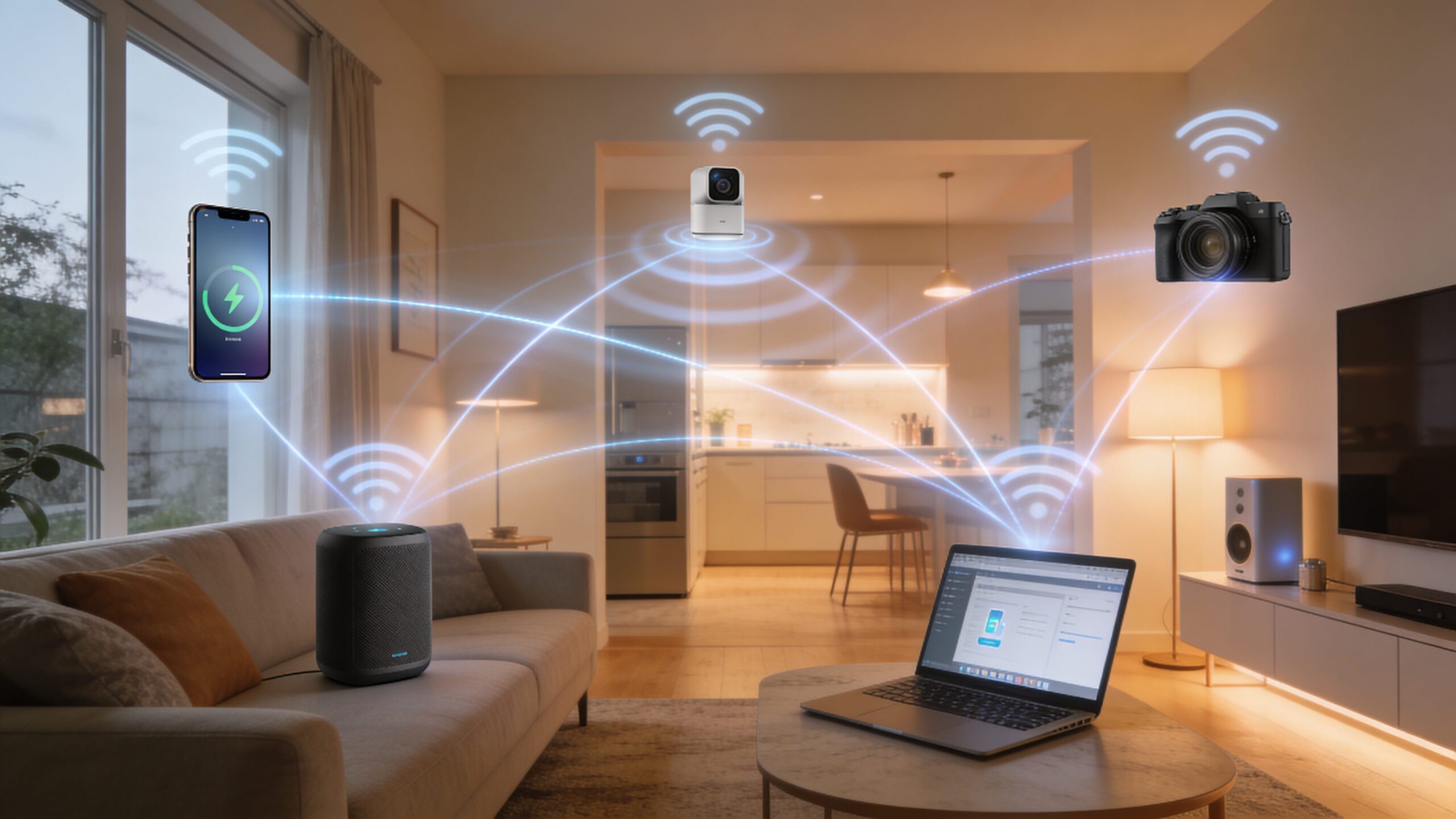
Wi-Fi 6 followed several years later, arriving to address a growing challenge: modern networks were becoming crowded. Households no longer contained a handful of devices. Instead, homes now routinely support dozens of connected products ranging from smartphones and laptops to smart speakers, security cameras, thermostats, televisions, and gaming systems.
Wi-Fi 6 was specifically designed for this new reality.
Speed: The Most Visible Difference
When comparing wireless technologies, speed is often the first specification people examine.
Wi-Fi 5 supports theoretical maximum speeds of approximately 3.5 Gbps under ideal conditions. Wi-Fi 6 increases that ceiling dramatically, reaching theoretical speeds approaching 9.6 Gbps.
Those numbers sound impressive, but they rarely reflect real-world performance. Most internet service plans don’t deliver multi-gigabit speeds, and environmental factors such as walls, interference, and device limitations affect actual results.
The more meaningful advantage of Wi-Fi 6 isn’t necessarily that a single device becomes dramatically faster. Instead, the technology allows multiple devices to share available bandwidth more effectively.
In practical terms, a family streaming movies, gaming online, conducting video meetings, and operating smart home devices simultaneously will often experience smoother performance on Wi-Fi 6 than on Wi-Fi 5, even if internet speeds remain unchanged.
The Rise of Connected Homes
One of the biggest reasons Wi-Fi 6 was developed involves the explosion of connected devices.
A decade ago, a typical home may have supported a few smartphones and a laptop or two. Today, households commonly contain dozens of internet-connected devices.
Smart TVs stream ultra-high-definition content. Voice assistants remain connected around the clock. Security cameras continuously upload footage. Smart appliances communicate with cloud services. Gaming consoles download massive updates while smartphones sync photos and videos.
Wi-Fi 5 performs well with moderate device counts, but congestion can become noticeable as networks grow. Each device competes for access to wireless airtime, creating bottlenecks during busy periods.
Wi-Fi 6 introduces technologies specifically designed to handle dense environments. Rather than forcing devices to take turns as frequently, the network can communicate with multiple devices more efficiently, reducing delays and improving overall responsiveness.
OFDMA: The Secret Weapon of Wi-Fi 6
One of the most significant innovations in Wi-Fi 6 is a technology called Orthogonal Frequency Division Multiple Access, commonly abbreviated as OFDMA.
While the name sounds intimidating, the concept is relatively simple.
Imagine a delivery truck carrying packages to multiple homes. Under older systems, the truck might make separate trips for each destination. OFDMA allows that truck to deliver multiple packages during a single trip.
Applied to wireless networking, this means Wi-Fi 6 can serve several devices simultaneously within the same transmission.
The result is reduced latency, improved efficiency, and better performance when many devices are active at once.
This innovation may not appear dramatic during casual browsing, but it becomes extremely valuable in homes filled with connected gadgets or offices supporting dozens of users.
MU-MIMO Gets Better
Wi-Fi 5 introduced Multi-User Multiple Input Multiple Output, known as MU-MIMO. This technology allowed routers to communicate with multiple devices simultaneously rather than serving one device at a time.
However, Wi-Fi 5 primarily applied this capability to downloads.
Wi-Fi 6 expands MU-MIMO significantly by supporting both uploads and downloads across more simultaneous connections.
As a result, devices can exchange information with the router more efficiently in both directions.
Activities such as cloud backups, video conferencing, file sharing, and smart camera uploads benefit from these improvements, helping maintain smoother performance across the entire network.
Better Battery Life for Mobile Devices
Speed and capacity often dominate discussions about wireless networking, but Wi-Fi 6 also introduces benefits for battery-powered devices.
A feature called Target Wake Time enables devices to schedule communication more intelligently.
Rather than continuously checking for network activity, compatible devices can sleep for longer periods and wake only when needed.
This reduces unnecessary power consumption and helps extend battery life for smartphones, tablets, laptops, wearables, and smart home sensors.
While the savings may vary depending on usage patterns, the cumulative effect can be meaningful for devices that remain connected throughout the day.
Performance in Crowded Environments
Apartment complexes, office buildings, hotels, airports, and stadiums present unique challenges for wireless networks.
In these environments, dozens or even hundreds of nearby networks compete for limited wireless spectrum.
Wi-Fi 5 performs admirably, but congestion can still create slowdowns, interference, and inconsistent performance.
Wi-Fi 6 introduces technologies that improve spectrum utilization and reduce the negative effects of network crowding.
The result is more reliable connectivity, lower latency, and stronger performance even when numerous neighboring networks operate nearby.
For urban residents and office workers, this advantage can be one of the most noticeable benefits of upgrading.
Gaming and Streaming Advantages
Gamers and streamers are often among the first users to notice network limitations.
Online gaming demands low latency and stable connections. Streaming platforms require consistent bandwidth to deliver high-resolution content without buffering.
Wi-Fi 6 excels in both areas.
Because the technology manages network traffic more efficiently, latency often decreases and stability improves. Multiple users can stream, download, and browse simultaneously with less impact on gaming sessions.
For households where internet activity never stops, Wi-Fi 6 helps maintain smoother experiences across all connected devices.
Security Improvements
Security remains a critical concern for wireless networks.
While Wi-Fi 5 networks commonly use WPA2 security, Wi-Fi 6 devices increasingly support WPA3, the latest generation of wireless encryption standards.
WPA3 introduces stronger protections against password attacks and improves overall network security.
Although WPA3 is not exclusive to Wi-Fi 6, many modern Wi-Fi 6 routers include support for the newer protocol, providing an additional incentive for upgrading.
As cyber threats continue to evolve, stronger security becomes increasingly important for protecting personal information and connected devices.
Do You Need a New Router?
One common misconception is that simply purchasing a Wi-Fi 6 router instantly transforms every connected device.
In reality, both the router and the client device benefit most when they support Wi-Fi 6.
Fortunately, compatibility is not a concern. Wi-Fi 6 routers remain backward compatible with older Wi-Fi devices.
This means existing smartphones, laptops, tablets, and smart home products can continue connecting normally.
However, Wi-Fi 6 features become fully available only when both ends of the connection support the newer standard.
As more devices adopt Wi-Fi 6 capabilities, users gradually experience greater benefits across their network.
Is Wi-Fi 6 Worth the Upgrade?
The answer depends largely on your current situation.
If you have a small household with a handful of devices, moderate internet usage, and a reliable Wi-Fi 5 router, upgrading may not dramatically change your daily experience.
However, households with numerous connected devices often see substantial improvements.
Remote workers conducting video meetings, gamers seeking lower latency, families streaming multiple 4K videos, and smart-home enthusiasts can all benefit from Wi-Fi 6’s enhanced efficiency and capacity.
Additionally, anyone purchasing a new router today should strongly consider Wi-Fi 6 simply because it provides better future-proofing for evolving technology needs.
Looking Toward the Future
Technology continues to advance at a remarkable pace. Broadband speeds increase, streaming quality improves, cloud services expand, and connected devices become more common each year.
Wi-Fi 6 was designed to support this future by addressing challenges that traditional speed increases alone could not solve.
Rather than focusing solely on peak performance numbers, the standard improves how networks operate under real-world conditions where dozens of devices compete for bandwidth simultaneously.
This shift represents a major evolution in wireless networking philosophy.
Final Verdict
When comparing Wi-Fi 6 vs Wi-Fi 5, the most important takeaway is that Wi-Fi 6 is not merely a faster version of its predecessor. While higher theoretical speeds are certainly part of the package, the real advantages lie in efficiency, capacity, responsiveness, and reliability.
Wi-Fi 5 remains a capable technology and continues serving millions of homes effectively. However, as households become increasingly connected and internet demands continue to grow, Wi-Fi 6 offers meaningful improvements that extend far beyond raw speed.
For users who value smoother streaming, stronger gaming performance, better support for smart devices, enhanced battery life, and improved network stability, Wi-Fi 6 represents a significant step forward. In many ways, it isn’t just the next generation of Wi-Fi—it’s the generation built specifically for the connected world we live in today.