Signal processing sits at the heart of modern communication systems, quietly powering everything from phone calls and streaming media to wireless networks and satellite transmissions. At its core, signal processing is about capturing, analyzing, modifying, and transmitting information through signals. These signals can be continuous, like a human voice, or discrete, like digital data sent across the internet. Two primary approaches define how signals are handled: analog signal processing and digital signal processing. While they share the same fundamental goal, they differ dramatically in how they represent, manipulate, and transmit information. Understanding these differences is essential for anyone exploring communication systems, electronics, or modern technology infrastructure.
A: A changing physical or digital pattern that carries information.
A: Unwanted variation that makes the useful signal harder to recover.
A: It helps determine how much information can be carried.
A: It keeps useful parts of a signal and reduces unwanted parts.
A: A way to describe a signal by the frequencies inside it.
A: No. Digital systems still depend on physical signals and error handling.
A: Distance, routing, buffering, and processing can all add delay.
A: Only if it does not amplify too much noise.
A: They determine how well devices send and receive radio energy.
A: Communication improves when the useful signal is preserved and noise is controlled.
What Is Analog Signal Processing?
Analog signal processing deals with continuous signals that vary smoothly over time. These signals directly represent physical phenomena such as sound waves, temperature changes, or electromagnetic signals. In an analog system, the signal maintains its natural form, flowing continuously without interruption.
In practical terms, analog processing involves circuits composed of resistors, capacitors, inductors, and transistors. These components manipulate the signal in real time, shaping it through amplification, filtering, or modulation. For example, a traditional radio receives analog signals transmitted through the air and processes them directly to produce sound.
The defining characteristic of analog processing is its continuity. There are no discrete steps or numerical representations; instead, the signal is always in motion, reflecting real-world variations as they occur.
What Is Digital Signal Processing?
Digital signal processing, often referred to as DSP, operates on signals that have been converted into discrete numerical values. Before processing can begin, an analog signal must be sampled and quantized, transforming it into a digital format that computers and processors can understand.
Once in digital form, the signal can be manipulated using algorithms. These algorithms perform tasks such as filtering noise, compressing data, or enhancing specific features. Unlike analog systems, digital processing relies on software and programmable hardware, making it highly flexible and adaptable. Digital signal processing is the backbone of modern communication systems. From smartphones to streaming platforms, DSP enables efficient data transmission, error correction, and high-quality signal reproduction.
Core Differences Between Digital and Analog Signal Processing
The distinction between analog and digital signal processing lies in how signals are represented and handled. Analog systems work with continuous waveforms, while digital systems break those waveforms into discrete samples.
Analog processing occurs in real time without conversion, making it inherently fast and direct. However, it is also more susceptible to noise and distortion. Digital processing, on the other hand, introduces a conversion step but gains significant advantages in precision, flexibility, and reliability.
Another key difference is how each system handles noise. In analog systems, noise becomes part of the signal and can degrade quality over time. Digital systems can detect and correct errors, preserving signal integrity even in challenging environments. These differences shape how each approach is used across industries and applications.
Signal Representation: Continuous vs Discrete
In analog processing, signals exist as smooth, continuous waves. These waves can take on an infinite number of values within a given range. This allows for highly natural representations of real-world phenomena, such as audio signals that capture every nuance of a voice.
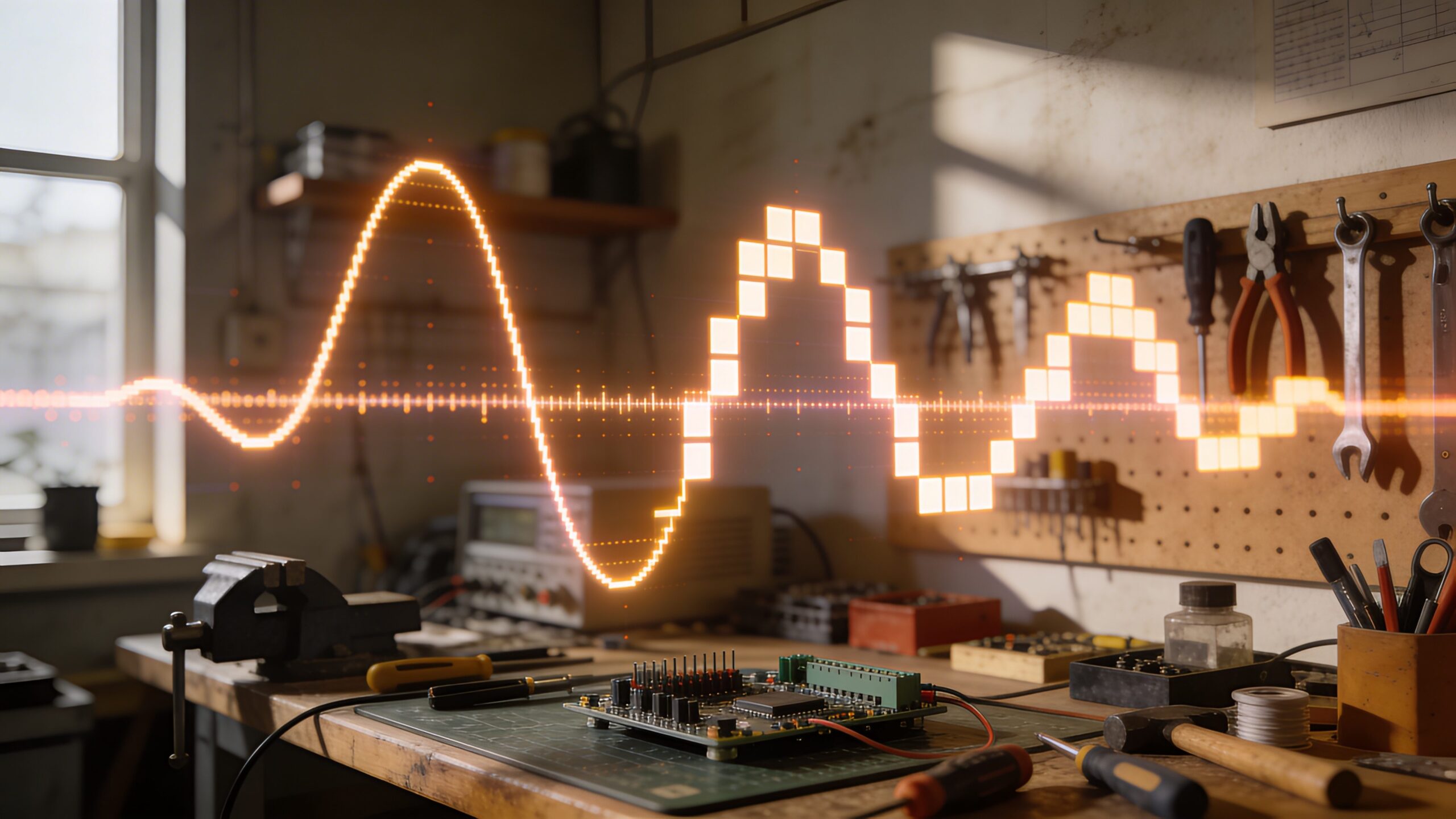
Digital processing converts these continuous signals into discrete samples. Each sample represents the signal at a specific moment in time and is assigned a numerical value. While this introduces approximation, modern sampling techniques ensure that the digital representation closely matches the original signal. The transition from continuous to discrete is one of the most important steps in digital signal processing, as it defines the accuracy and quality of the resulting data.
Accuracy and Precision
Analog systems offer theoretically infinite resolution because they are not limited by discrete steps. However, in practice, their accuracy is constrained by physical limitations such as component tolerances and environmental factors.
Digital systems, while limited by sampling rates and bit depth, provide consistent and repeatable precision. Once a signal is digitized, it can be processed with exact mathematical operations, ensuring predictable results.
This consistency is a major reason why digital signal processing dominates modern communication systems, where reliability and repeatability are critical.
Noise and Interference
Noise is an unavoidable part of any signal processing system. In analog systems, noise is directly added to the signal and cannot be easily separated once introduced. Over time, repeated amplification and transmission can significantly degrade signal quality.
Digital systems approach noise differently. Because signals are represented as discrete values, it is possible to detect and correct errors using algorithms. Techniques such as error correction codes and filtering allow digital systems to maintain high-quality signals even in noisy environments. This ability to combat noise is one of the defining advantages of digital signal processing.
Flexibility and Scalability
Analog systems are typically fixed in their design. Changing how a signal is processed often requires modifying the physical circuitry, which can be complex and costly.
Digital systems offer unparalleled flexibility. Signal processing algorithms can be updated, optimized, or replaced through software changes. This makes it easy to adapt to new requirements, improve performance, or introduce new features without redesigning hardware.
Scalability is another advantage of digital systems. As processing power increases, digital signal processing can handle more complex tasks and larger volumes of data.
Real-Time Performance
Analog signal processing excels in real-time applications because it operates directly on the signal without delay. This makes it ideal for applications where immediate response is critical, such as certain control systems and audio amplification.
Digital systems introduce latency due to sampling, conversion, and processing. However, advances in hardware have significantly reduced these delays, making real-time digital processing feasible for most applications. In many cases, the slight delay in digital systems is outweighed by their benefits in accuracy and flexibility.
Hardware vs Software Implementation
Analog signal processing relies entirely on hardware components. These components are designed to perform specific functions, such as filtering or amplification, with high efficiency.
Digital signal processing combines hardware and software. Specialized processors handle computations, while algorithms define how signals are processed. This hybrid approach allows for greater adaptability and innovation.
The shift from hardware-based analog systems to software-driven digital systems has transformed the field of signal processing, enabling rapid advancements and widespread adoption.
Applications of Analog Signal Processing
Analog signal processing remains essential in areas where direct interaction with physical signals is required. Audio equipment, radio frequency systems, and sensor interfaces often rely on analog processing for initial signal capture and conditioning.
In many cases, analog processing serves as the first stage in a larger system, preparing signals for digital conversion. This highlights the continued importance of analog techniques in modern technology.
Applications of Digital Signal Processing
Digital signal processing is everywhere. It powers communication networks, multimedia systems, medical imaging, and more. In communication systems, DSP enables efficient data transmission, compression, and error correction.
Modern technologies such as wireless communication, streaming platforms, and smart devices rely heavily on digital processing to deliver high-quality performance and seamless user experiences.
The versatility of DSP makes it a cornerstone of innovation in communication systems and beyond.
Advantages and Limitations
Analog signal processing offers simplicity and real-time operation, but it struggles with noise, scalability, and flexibility. Digital signal processing excels in precision, adaptability, and noise resistance, but it requires conversion and computational resources.
The choice between analog and digital processing depends on the specific requirements of an application. In many cases, a combination of both approaches provides the best results.
The Hybrid Approach in Modern Systems
Modern communication systems rarely rely exclusively on one approach. Instead, they combine analog and digital processing to leverage the strengths of each.
Signals are typically captured and conditioned using analog techniques before being converted into digital form for processing. This hybrid approach ensures high-quality signal representation while enabling advanced processing capabilities. The integration of analog and digital methods reflects the evolving nature of signal processing and the need for versatile solutions.
Future Trends in Signal Processing
The future of signal processing is closely tied to advancements in computing power and artificial intelligence. Digital signal processing continues to evolve, incorporating machine learning techniques to analyze and optimize signals in real time.
At the same time, analog technologies are improving, offering more efficient and precise components. The combination of these advancements is driving innovation in communication systems, enabling faster, more reliable, and more intelligent networks.
As technology continues to advance, the line between analog and digital processing may blur, leading to new approaches that combine the best of both worlds.
Final Thoughts
Digital and analog signal processing represent two fundamental approaches to handling signals, each with its own strengths and limitations. Analog processing provides a direct and continuous representation of real-world signals, while digital processing offers precision, flexibility, and resilience. In modern communication systems, digital signal processing has become the dominant approach, enabling advanced features and high-performance applications. However, analog processing remains essential, particularly in the initial stages of signal capture and conditioning.
Understanding the differences between these two methods provides valuable insight into how communication systems work and why they continue to evolve. As technology progresses, the collaboration between analog and digital processing will remain a key driver of innovation.